

ROS Lesson Acceptance: Identify the Managed Node State
2026-11-02
ROS Lesson Acceptance: Identify the Managed Node State
A managed node state gives a ROS learning exercise a more precise context than a statement that the program started. A buyer accepting a training package should ask what the lesson demonstrates about configuration, activation, and the work that follows. This article proposes a review of a fictional managed-node lesson. It launches no process, sends no transition request, and operates no robot hardware.
Specify the learning outcome before accepting the demonstration
Ask the course author which distinction a learner is supposed to understand. Reading a state, requesting a transition, and observing application behavior are related activities, but they are not the same learning outcome. The delivery should explain which ones the exercise actually covers.
The receiving reviewer should identify the ROS distribution, lesson revision, and example implementation intended by the course. A generic lifecycle diagram can introduce the concepts without establishing the behavior of the delivered exercise. Keep the educational model attached to the actual example the author asks students to use.
Ask how the instructor expects a learner to explain an unsuccessful transition as well as a successful one. The teaching package should provide a place to retain that observation and its context. Otherwise a learner may mistake the intended diagram for the outcome of every exercise.
For the proposed acceptance conversation, no node state is observed. Leave the observation field open until an authorized review is performed. A realistic-looking terminal screenshot copied from documentation would not become a record of the supplier’s lesson simply because it resembles the expected activity.

Distinguish configuration from activation in the model
The ROS 2 lifecycle design describes Unconfigured, Inactive, Active, and Finalized primary states, with transition states between them. In the described model, configuration leads from Unconfigured to Inactive, while activation leads from Inactive to Active.
That distinction gives the buyer a concrete question: does the lesson explain why configuration completion is different from activation? A course should not use a single ready label to hide both ideas. The learner needs to know which state and transition the teaching material is discussing.
The design explains intended managed behavior in those states. A reviewer should retain that scope rather than turn the model into an unsupported guarantee about every callback, extension, or arbitrary application. The supplied implementation and its actual behavior still need to be understood in their own context.
Connect the conceptual diagram to the supplied example
The official Jazzy Managed Nodes tutorial introduces lifecycle nodes and points to the implementation, interfaces, and demonstration materials. It provides a documented starting point for an educational exercise, not evidence that a separate training package has been executed successfully.
Ask the author which parts of the example are included and which dependencies are expected from the learner’s environment. The acceptance note should identify the actual lesson materials rather than refer vaguely to the official demo. A link is useful context but not a substitute for the promised deliverable.
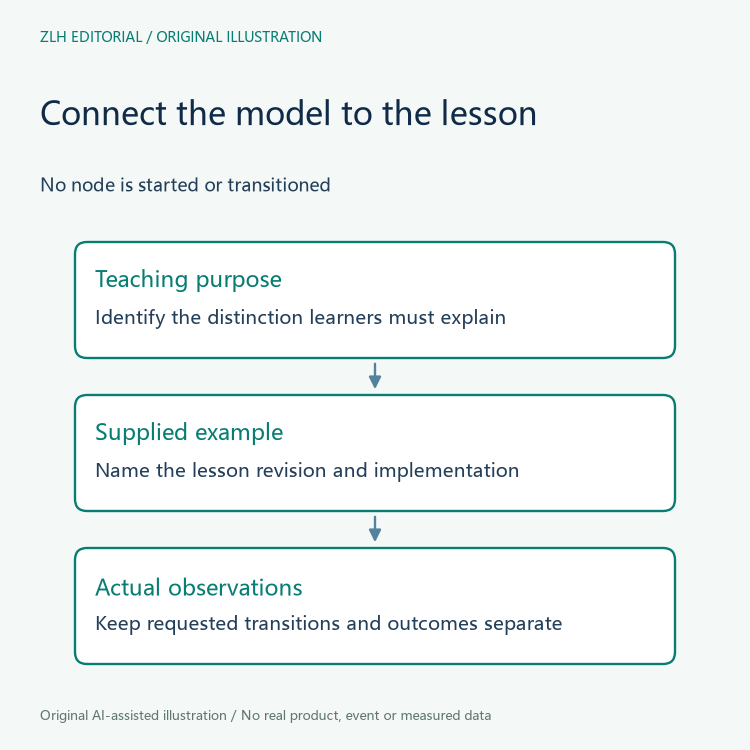
If the course modifies the example, request a description of the changes. The reviewer should know whether the lesson still illustrates the same transition relationships or adds application-specific work. A borrowed diagram should not conceal a different exercise behind familiar terminology.
Ask for observations that distinguish request and outcome
A later authorized lesson review can record the initial state, the requested transition, and the resulting observation. These should remain separate entries. Merely showing that a request was issued does not describe the state ultimately reported or the application work actually observed.
Keep unsuccessful or ambiguous observations in the review. If a transition does not produce the expected teaching result, ask the author to explain the relevant condition. Do not edit the exercise transcript to make the conceptual diagram appear confirmed when the actual behavior was different.
This article supplies no commands or production procedure. An educational lifecycle example should not be transferred unexamined to physical equipment. Real hardware use, system readiness, and work-area controls belong to the authorized operational context and cannot be established by completing a classroom explanation.
Accept the lesson with its scope visible
A useful learning handover identifies the intended concept, the supplied implementation, the documented transition model, and the actual exercise observations. Where a part remains unexamined, say so. The buyer can then decide whether the agreed teaching outcome has been demonstrated.
When the lesson changes, ask which transitions and observations need renewed review. Preserve earlier records with their original environment and exercise revision. A familiar state name should not carry an old acceptance result into a substantially changed implementation.
More learning notes appear in our ROS learning section and the reading directory. The original illustrations contain no live state reports, terminal output, robot actions, or completed classroom trial.


