

ROS Learning Practice: Read Sequence Bounds in Context
2026-11-03
ROS Learning Practice: Read Sequence Bounds in Context
A learner sees a sequence field in a ROS interface and treats the bound as the number of items a robot always publishes. That interpretation confuses a declaration with an observation. Sequence bounds describe a type constraint in an applicable interface definition; a particular message needs separate inspection. This exercise explains how to read that distinction from documentation without starting a node, subscribing to a topic or claiming to have observed a robot.
Start with the interface used by the lesson
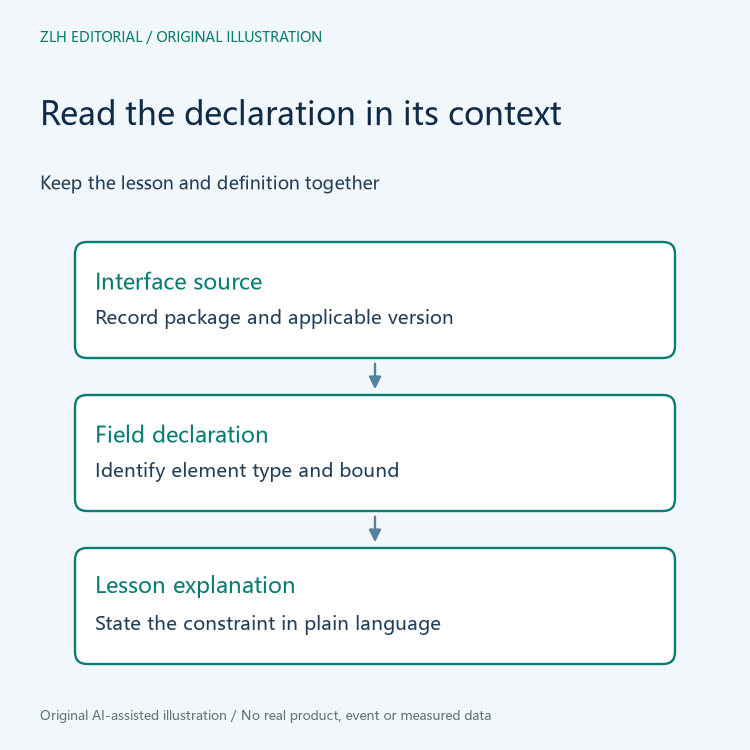
Record the package, interface name, definition file and lesson environment. Keep the package version or source revision when available. An identically named field in another package is not automatically the same interface. If the lesson links to a moving documentation page, preserve the actual definition being discussed rather than assuming that the current page matches an installed workspace.
Check whether the material uses IDL or the familiar message-definition format. The notation needs to be interpreted in its own context. Do not copy a fragment into a different file format merely because the type names look related. A reading exercise should retain enough surrounding structure to identify the field and its element type.
Read the declared constraint without inventing a value
The ROS design article on IDL interfaces and language mapping distinguishes unbounded sequences from sequences with a maximum number of items. It also describes fixed-size arrays separately. These are different declarations; a maximum is not a statement that every message contains that many elements.
This design article was written in 2019 and lists a 2020 modification. Treat it as an explanation of the documented design, not as a new release announcement or blanket claim about every installed distribution. Confirm the lesson's actual interface and implementation documentation before extending the reading into a runtime compatibility statement.
Write the declaration in words. Identify the element type, whether the sequence has an explicit bound and what that bound constrains. Keep a field's name separate from its meaning in the application. A name suggesting detections, waypoints or readings does not by itself identify units, ordering rules or the meaning of an empty sequence.
Compare formats through their documented mapping
The companion design page on message, service and action definition files explains their structure and mapping context. It was written in 2019 and modified in 2021. Use the applicable description to interpret the syntax present in the lesson rather than inferring a mapping from punctuation alone.
Keep an annotated copy of the relevant declaration with the source reference. If an instructor provides a different definition, ask which package revision it comes from. Differences may represent a changed interface or simply different examples. Do not merge the definitions into a single assumed type until the relationship has been established.
Observe a message only as a separate authorized step
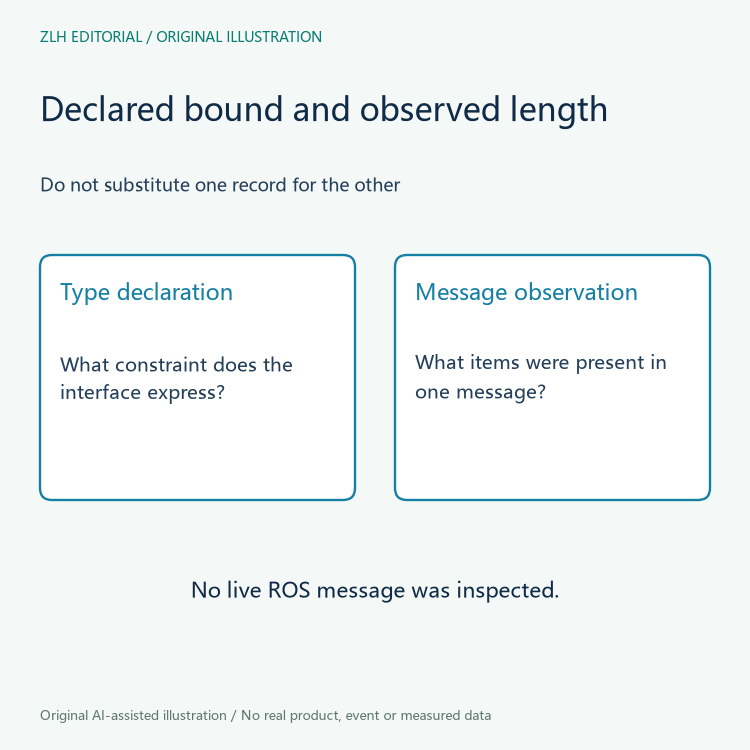
If a later lesson includes message inspection, record its environment, interface identity and actual observation conditions. The number of items seen in that observation belongs to that message record. It should not overwrite the declared bound or be generalized into a guarantee about future messages.
Likewise, the presence of a bound does not by itself establish allocation behavior, delivery rate, transport reliability or application safety. Those properties require implementation-specific evidence and an appropriate exercise. This article does not test generated code or assert when a particular language binding enforces a constraint.
Turn the reading into a useful lesson note
A completed note should include the definition source, package identity, field declaration, plain-language interpretation and questions left to the application documentation. Keep the type-level interpretation separate from any later observed values. An instructor can then see whether a learner misunderstood the notation or lacked the application explanation.
When updating the lesson, compare the old and new definitions before reusing the explanation. A changed bound or element type can affect the lesson even if its screenshot and field name look unchanged. Record the revision and revise the affected explanation explicitly, leaving earlier notes identifiable instead of silently presenting them as current.
The two original diagrams are conceptual learning aids without real message values. Related exercises appear in the robot learning pathway collection and article directory. An optional practice question is to ask which evidence would resolve a particular uncertainty. The definition answers the type constraint; an application description explains what the field represents; an observation record describes one actual message. Require the learner to name the appropriate source rather than selecting the longest available explanation. No fabricated example values are needed to assess that distinction. The instructor can review the reasoning without connecting to a robot or changing the learning environment. Reading a declaration carefully gives the learner a precise type question to answer before moving on to observations of a working system.


