

ROS Sync Lesson Acceptance: Read the Full Timestamp
2026-11-04
ROS Sync Lesson Acceptance: Read the Full Timestamp
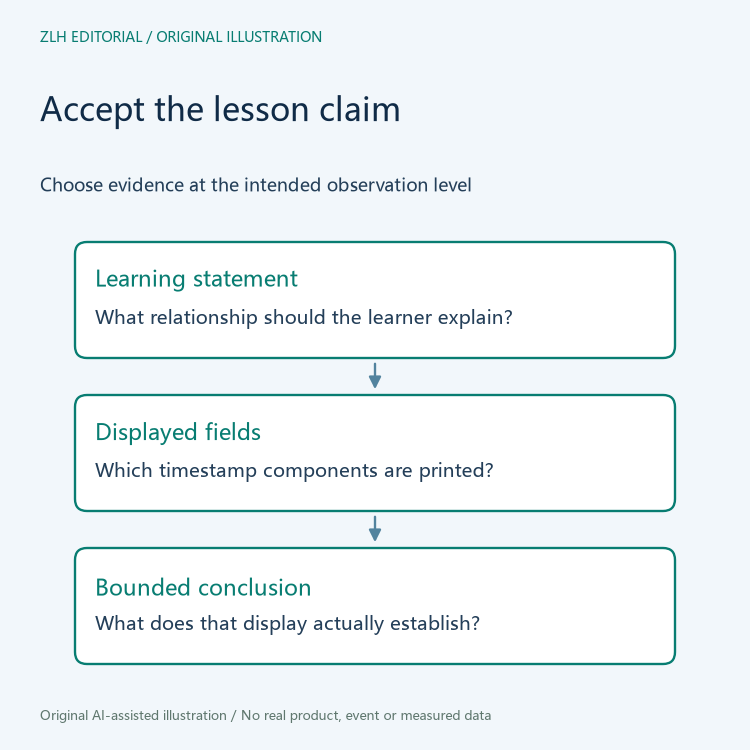
A ROS sync lesson can print two matching time values while leaving a learner unsure what actually matched. If the log displays only the seconds component, it does not show every component of the message timestamp. Acceptance should therefore begin with the learning claim and the evidence displayed for it. This article reads an official synchronization tutorial alongside a Time message definition. It does not execute the example, tune a synchronizer or report that any sensors were aligned.
State what the learner should be able to distinguish
The teaching outcome might be to identify a synchronized callback, explain which messages reach it or investigate the relationship between their complete timestamps. These are related but different outcomes. A delivery should say which one the learner is expected to demonstrate. A screenshot of a log may support one outcome while leaving another unresolved.
For a hypothetical lesson review, suppose an exercise says that two printed values prove exact timestamp equality. The reviewer should first identify the fields used to construct those values. If the output omits part of the timestamp, the lesson needs either a narrower conclusion or additional evidence. This fictional example describes an acceptance question rather than an observed mistake in a learner's own program.
Inspect the fields actually printed by the example
The official rolling Approximate Time Synchronizer Python tutorial includes a callback that reads the sec component of each message header stamp and prints those values. A reviewer can identify that selection directly in the published source. The displayed numbers should consequently be described as seconds components rather than automatically called complete timestamps.
This observation does not invalidate the entire tutorial or establish a failure of the synchronization algorithm. It identifies the information available in one displayed statement. Keep that scope clear when discussing what the log can demonstrate. A classroom explanation should not claim that every part of a message was compared simply because two selected fields were shown together.
The tutorial is a software example using named message types and simulated publications. Its published output belongs to the documentation. A learner may explain it, but should not copy it into a lab record as evidence of a local run. The source of the output remains part of the lesson's evidential account.
Read the complete Time representation
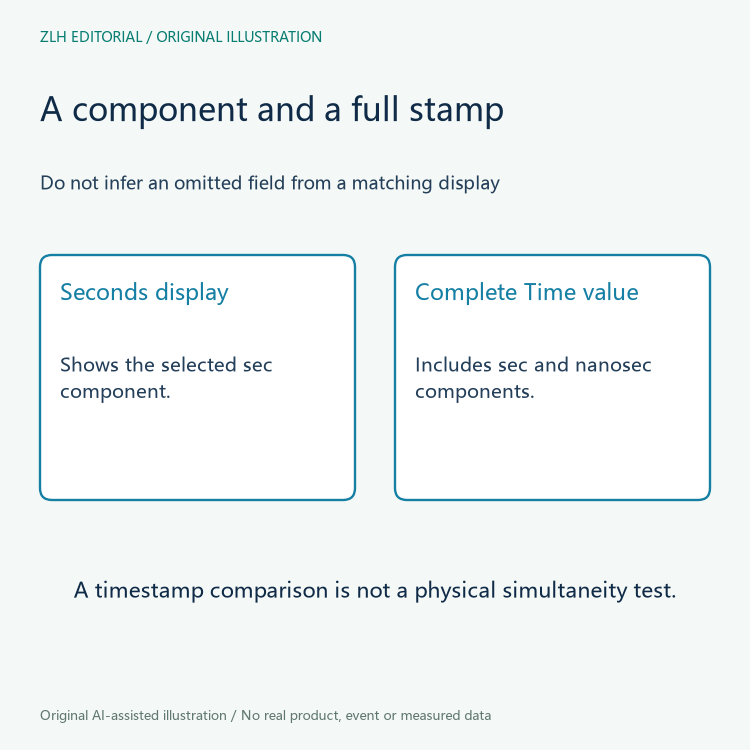
The official Jazzy builtin_interfaces Time definition declares sec and nanosec components and describes the nanoseconds component as added to the seconds component. Matching the first component alone therefore does not establish that both complete representations are equal. The lesson should preserve that distinction when drawing a conclusion from its output.
The two linked sources have different documentation contexts: a rolling tutorial and a Jazzy message-definition branch. They are identified here for a bounded reading of what a displayed field means. A reproducible classroom delivery should separately identify its actual distribution and applicable message definition. This article does not assert that an unknown installation matches either reference.
A conceptual comparison can explain this without inventing sensor data. The structural explanation is sufficient: the omitted component remains unobserved in that display. If the learning goal requires comparison of complete stamps, the contributor should provide a method and retained output appropriate to that goal. It should remain an authorized software exercise with its own environment record.
Separate timestamp evidence from physical simultaneity
Even a comparison of complete message stamps would answer a software-data question. A claim about when physical sensors acquired observations needs an account of how those timestamps were produced and related to acquisition. The two sources used here do not provide a measurement of the learner's hardware. A lesson should not move silently from displayed values to a claim of exact physical simultaneity.
Ask the contributor to name the observation level in the delivered explanation: selected field, complete message stamp, callback behavior or physical acquisition. Missing evidence at one level should be listed explicitly. Avoid using increasingly precise-looking formatting to imply accuracy that has not been assessed. Display resolution and an established measurement relationship are different concerns.
Close the lesson with a demonstrable learning statement
An acceptance note can say that the learner identified which timestamp fields were printed and explained the limitation of that display. If the course also promises execution evidence, retain the actual run context and output as a separate item. Do not mark the runtime task complete merely because the documentation example is understandable.
The original diagrams contain no sensor trace or invented timestamp. Further reading is available through the robot learning pathways collection and the article directory. Matching the lesson's conclusion to the fields actually observed helps a tutor assess understanding while preserving the remaining questions about runtime behavior and physical acquisition.


