

ROS Lesson Logs: Deadline Events and Message Loss
2026-11-04
ROS Lesson Logs: Deadline Events and Message Loss
Deadline events in a ROS lesson log should not automatically be renamed as lost messages. A timing expectation and a message-loss status have different meanings, even when both expose counters. A maintenance note should identify the actual status before explaining a count to learners. This article reads official Jazzy documentation and RMW status definitions. It does not run ROS, change a communication policy or determine why an actual sensor stream was interrupted.
Preserve the status name with the observation
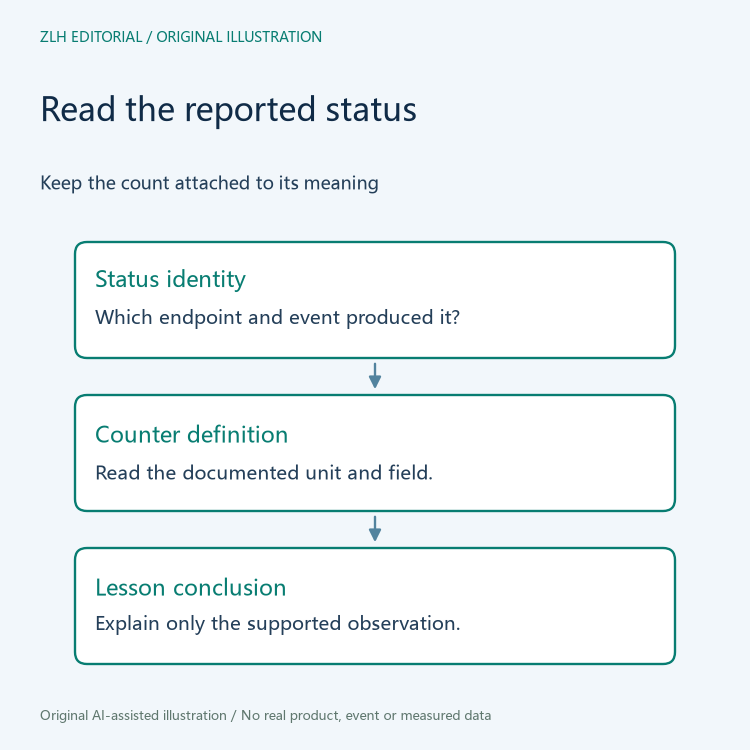
Start with the original log statement, the endpoint it concerns and the context supplied by the lesson author. A worksheet that copies only a number into a column called errors loses the information needed to interpret that value. Ask which callback or status produced it and which part of the example the learner was expected to observe.
In a hypothetical lesson report, a student labels a requested-deadline status counter as missing packets. The tutor should first request the original status name and the basis for that translation. This fictional example reports no actual network failure. A mismatch in explanatory labels can be addressed without inventing a physical cause or pretending that a local experiment was performed.
Read the deadline event as a timing observation
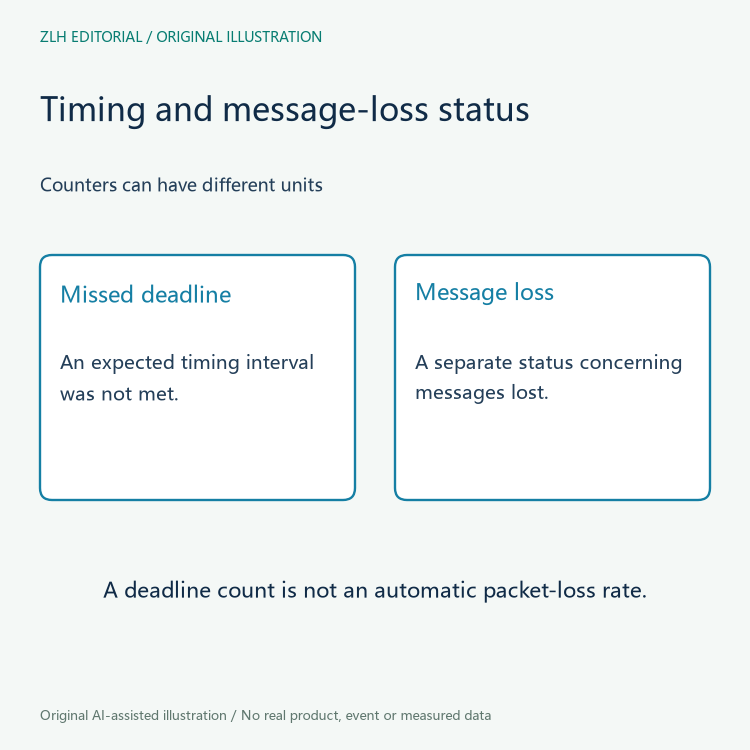
The official ROS 2 Jazzy Quality of Service explanation describes requested deadline missed in relation to a subscription not receiving a message within the duration established by the deadline policy. It separately describes offered deadline missed on the publishing side. The endpoint and policy context belong in the learning explanation.
A statement about a subscription's expected interval does not, by itself, identify the number of packets lost in a network or establish the cause of a delay. The recipient should preserve what was observed and ask for additional evidence if the lesson promises a broader diagnosis. Avoid turning one event label into a complete account of every communication layer.
The documentation also discusses QoS compatibility. That is a separate question from interpreting a particular deadline status. A maintenance note should not assume that every publisher and subscription in an unidentified exercise had a compatible configuration merely because the teaching material mentions deadline events.
Read what the requested-deadline counter counts
The official Jazzy requested-deadline status definition describes a lifetime cumulative count of missed deadlines detected for instances read by a subscription. Its comment explains accumulation by deadline period for each instance lacking received data. That definition concerns missed timing expectations rather than a direct count of lost messages.
The definition also distinguishes the cumulative value from its change since the status was read. Preserve the actual field used by the lesson when discussing successive log lines. Do not compare a cumulative value in one screenshot with an incremental value in another as though they were identical observations. The labels and collection context should make the difference understandable.
No numerical conversion is supplied here. The two counters do not provide enough information to reconstruct an arbitrary message sequence or calculate a packet-loss rate. If an exercise requires such a measure, it needs a method and retained data suited to that separate question.
Keep message-loss status as its own evidence type
The official Jazzy message-loss status definition describes a different structure whose counters concern messages lost. Reading the two definitions together supports a straightforward correction: preserve the status type that actually produced each count instead of renaming one structure after another.
These definitions do not demonstrate which events an unknown middleware and application exposed during a particular run. Nor does a callback's absence establish that no timing or loss issue occurred. The lesson author should identify the actual environment and evidence collected. This article reviews the meaning of the documented structures without claiming that all runtime observation paths were exercised.
A tutor can ask learners to explain the distinction using the documentation before requesting a permitted software demonstration. Keep the reading task and execution task separately recorded. Copying example output into a lesson worksheet should never be presented as the learner's own runtime observation.
Close the lesson issue with a precise interpretation
A revised note can say which status was reported, which endpoint and field it concerned, and what conclusion the count supports. If the original network explanation remains unverified, retain that limitation. A clearer label resolves an interpretation problem; it does not repair a communication system or establish physical sensor reliability.
The original diagrams contain no timing trace or invented packet count. Related reading appears in the robot learning pathways collection and the article directory. Keeping deadline events and message-loss status distinct gives learners a more accurate account of what their evidence can actually show.


