

ROS Service Introspection: Metadata and Contents Differ
2026-11-05
ROS Service Introspection: Metadata and Contents Differ
Service introspection in a ROS learning appendix can show that an interaction was observed without showing the request or response data. A student who sees empty content fields should therefore check the documented observation mode before concluding that the application sent an empty request. This article reads the ROS 2 Jazzy tutorial and its matching rcl declaration through a hypothetical course handout. It starts no nodes, changes no parameters and makes no service calls.
Which three observation states does Jazzy describe?
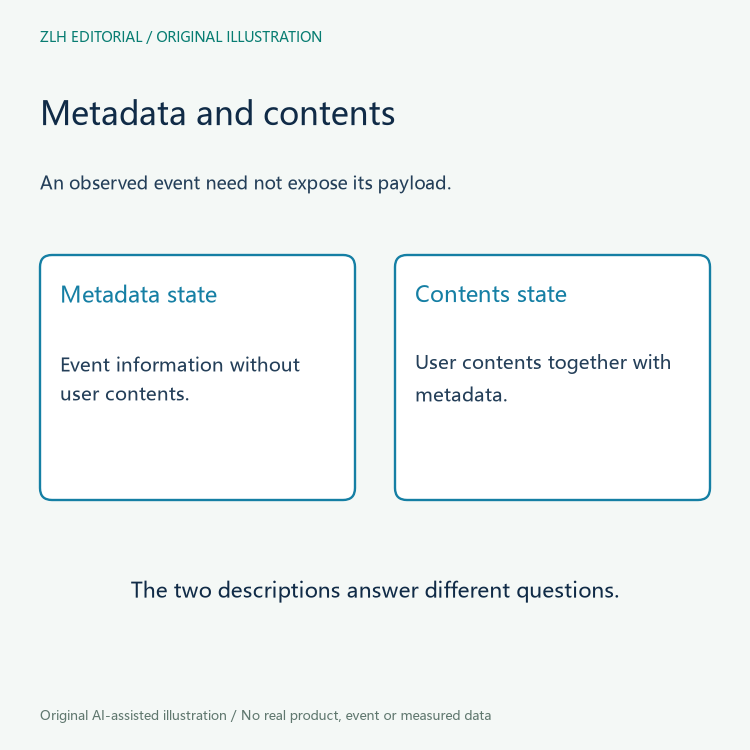
The official Jazzy service-introspection tutorial distinguishes disabled observation, metadata-only observation and observation that includes user contents with metadata. Its explanation establishes a meaningful difference between seeing an event and seeing the data carried by that interaction. The documentation also says that service communication is not observable this way by default; appropriate configuration is required.
For the hypothetical handout, retain the stated observation mode beside the submitted excerpt. A heading such as service trace is too broad to explain what information was intentionally included. Ask the author whether a screenshot represents a metadata account or a content-bearing account. This question concerns the evidence supplied to the learner. It does not presume that a particular classroom system was configured correctly or that the submitted capture is complete.
The matching Jazzy rcl service-introspection header names the three states OFF, METADATA and CONTENTS. Its comments preserve the distinction between metadata alone and metadata plus contents. These declarations support the vocabulary used here; they are not proof that an unknown running client or server selected any particular state. A copied constant name is still documentation until linked to an actual account of the application.
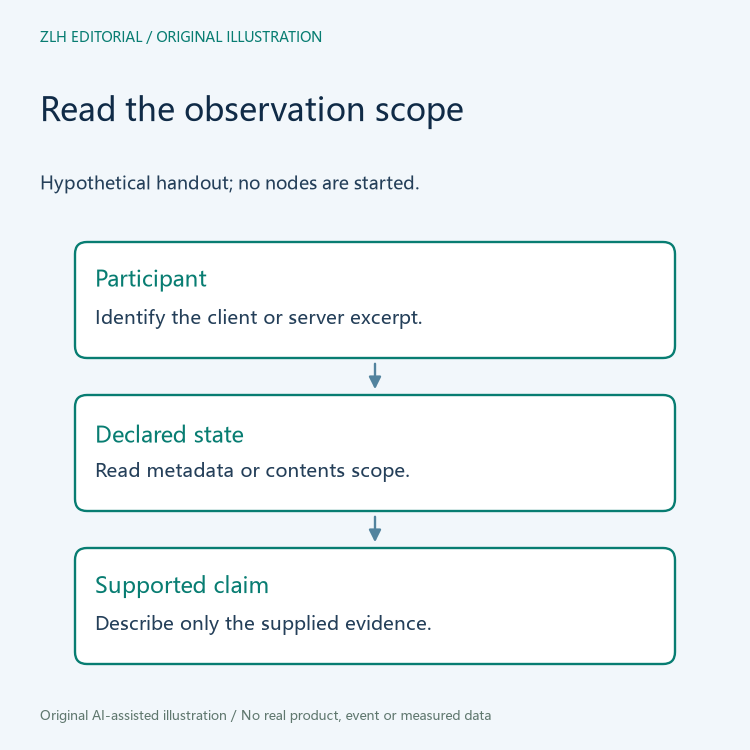
Why must the client and server remain separate?
The tutorial describes introspection configuration for both participants and provides an example where their states differ. Its example attributes content-free client events to a metadata setting while server events include the corresponding contents under a contents setting. A learner should keep that participant explanation attached to the example. Combining all event rows into one unnamed trace can erase the reason that apparently related rows expose different information.
Suppose a hypothetical lab report includes one client-side excerpt and one server-side excerpt. Before comparing their visible fields, identify which excerpt belongs to which participant and what the report says about its observation mode. The author might then explain an intentional difference in capture scope. Without that account, a reviewer should mark the relationship unresolved rather than label one participant faulty simply because the excerpts display different amounts of data.
What does an empty content field establish?
An empty request or response field in an observation is an attribute of that observation. It should not automatically become a statement about the actual application payload. The source example supplies a specific configuration-based explanation for its empty fields. That explanation is useful for learning how to read the example, but it should not be copied as the explanation for every unrelated empty field in a submitted project.
In the hypothetical report, ask whether the author intended to demonstrate event visibility, data contents or an application result. Those are three different claims. A metadata excerpt may support a carefully bounded description of observed event information. A result claim needs its own attributable evidence and explanation. This article has captured no messages and has verified no arithmetic, response correctness, completion rate or robot behaviour.
A corrected caption can describe the excerpt as a metadata-only observation from the named participant, if that is what the contributor's actual record establishes. Avoid silently adding missing request values from a separate example. Doing so would make the handout appear more complete while disconnecting the displayed values from the observation that supposedly produced them. Preserve any supplied content-bearing excerpt as a separately identified object.
How can a course handout state the limitation clearly?
A useful handout names ROS distribution, participant, observation state and the purpose of the excerpt. If the excerpt has been shortened, its caption should identify the omission. These details make the learning question answerable: which information did this observation mode expose? They also keep a diagram from being mistaken for a complete live transcript. Both figures here are conceptual reading aids, with no event identifiers or captured values.
Version context matters because the cited tutorial belongs to Jazzy and the header is taken from its Jazzy branch. A project using another distribution needs its own applicable source account. Familiar state names alone do not establish identical software behaviour across releases. Retaining the distribution and source snapshot lets a later reader understand exactly which documentation supported the terminology explanation.
Related material is available in the robotics learning category and course-resource category. Reading service introspection through its metadata and contents distinction gives learners a precise evidence question. Claims about the actual application's requests, responses and outcomes remain attached to the actual records that can support them.


