

Robot Geometry Learning: Points and Free Vectors
2026-11-05
Robot Geometry Learning: Points and Free Vectors
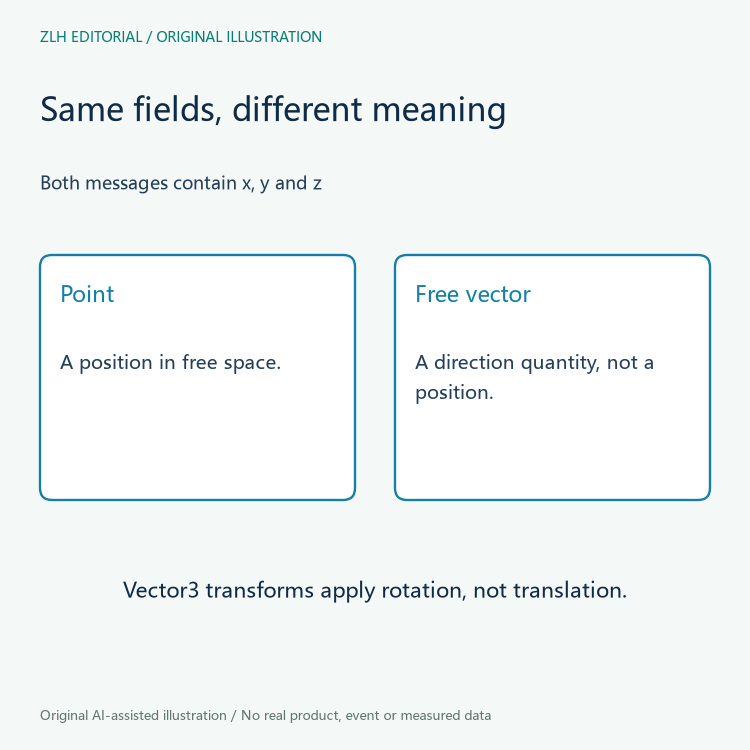
Free Vectors and points can appear nearly identical in a robot course handout: both may be written with x, y and z fields. Their geometric meanings still differ. The ROS geometry_msgs definitions describe Point as a position in free space and Vector3 as a free vector. That difference matters when a reader explains what a coordinate transformation does. This article reads the Jazzy message definitions, without calculating a transform or sending any value to a robot.
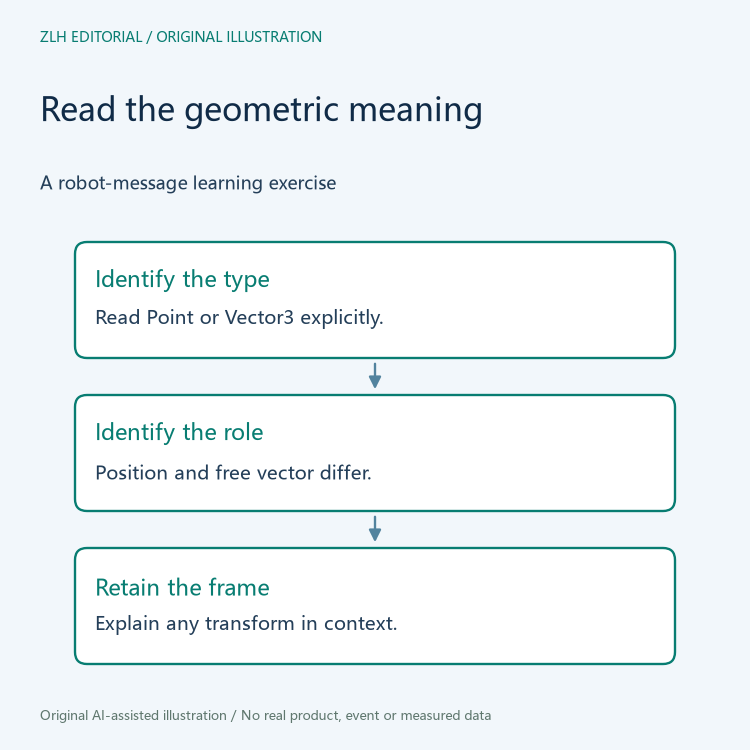
Begin with the type, rather than the three field names
A screenshot showing three numbers does not fully identify the quantity. The surrounding type declaration may say Point, Vector3 or a larger message containing one of them. Record that declaration before interpreting the numbers. A familiar x label can describe one component of several different geometric objects; it is not sufficient evidence that every object represents a location.
For a learning exercise, preserve the exact message path and the version of the documentation used. The two sources here belong to the Jazzy geometry_msgs documentation, showing package version 5.3.8 when read on November 5, 2026. The purpose is to explain the supplied definitions, not to infer the meaning of an unidentified export from a different software system.
Read Point as a spatial position
The official Point definition describes a point in free space, represented by three float64 fields. Its role is positional. To interpret an actual value, a reader still needs the coordinate context supplied by the enclosing record or interface. The bare definition does not tell us which real-world landmark a particular application chose to represent.
A course diagram might use a point to mark the position of an illustrated object feature. That is a hypothetical teaching use, not an observation of a robot or a measurement of the feature. The important question is what the value locates and in which coordinate context. It should remain separate from a statement about a direction drawn from one place to another.
Read Vector3 as a free vector
The official Vector3 definition explicitly distinguishes a free vector from a point. Its comments emphasize direction and explain that a transformation applied by tf2 uses rotation rather than the translation part. This is the semantic distinction the similar field layout can hide. The meaning of the type determines how a transform should be understood.
A free vector does not acquire the meaning of a position just because a drawing displays an arrow somewhere on a page. The arrow's placement can help illustrate its direction, but that placement is not automatically the position encoded by the vector. A handout should name the geometric role instead of making the reader infer it from the visual location of a decorative arrow.
Explain why a shifted origin affects the questions differently
In a conceptual frame illustration, asking where a point is located differs from asking which way a vector points. A different frame origin changes the positional reference used for the first question. The Vector3 documentation's rotation-only rule prevents the translation component from being treated as an added displacement of the free vector. No numeric transform is needed to state this distinction.
Rotation can still matter to the vector's component representation. The rule does not say that every vector keeps identical x, y and z components in every frame. It says that translation is excluded from the documented transform treatment of this type. This avoids replacing one misunderstanding, “all triples are positions,” with another, “a free vector never changes under any transformation.”
Review a fictional notebook explanation
Imagine a fictional student note containing two triples and saying both must receive the same origin offset because both have x, y and z. The first triple is explicitly typed Point and the second Vector3. The correction is to return to those declared meanings and explain which transformation parts apply. This invented example contains no real coordinates, sensor observations or executable code.
If the note omitted both types, the appropriate conclusion would be that the supplied evidence is incomplete. It would be premature to label one triple a vector based on its values or to infer that another identifies a tool position. A useful exercise distinguishes what the definition establishes from what the surrounding application still needs to state.
Keep the learning conclusion tied to the messages
The definitions explain the semantic role of these two messages. They do not identify the real-world frame, the physical unit of an unspecified record or the accuracy of a sensor. A message-reading exercise can improve a student's explanation without becoming a calibration procedure or an instruction to transform live robot data. The original figures remain conceptual and contain no calculated result.
For follow-up, use the robot learning document collection and article directory. A concise notebook entry can retain the declared type, the positional or free-vector role and the coordinate context. Keeping those three items together makes the shared x, y and z fields understandable without erasing the different geometry they represent.


