

Robot Line Markers: Connected Strip and Separate Pairs
2026-11-05
Robot Line Markers: Connected Strip and Separate Pairs
Robot Line Markers can use the same ordered point list while describing different connections. In RViz, LINE_STRIP connects consecutive points, whereas LINE_LIST groups points into separate pairs. A learning appendix needs the marker type before it interprets a visible line pattern. This article reads ROS 2 Jazzy documentation only. It publishes no marker, draws no actual scene, computes no coordinates, and makes no claim about a robot's route.
A line strip connects successive entries
The official RViz marker-type tutorial describes a line strip as drawing between each pair of consecutive points. The end of one segment participates in the next segment through the ordered list. The list's ordering is therefore part of the explanation, rather than a collection of unrelated endpoint pairs.
Suppose a fictional lesson attaches an ordered set of points and calls it a connected outline. Ask which marker type the explanation actually names. A point list alone does not establish the intended connectivity. The lesson should retain the type beside the list so a learner does not have to guess the connection rule from a screenshot.
A line list groups entries into separate pairs
The same tutorial describes LINE_LIST as connecting successive pairs rather than connecting every adjacent entry. This produces a different connection pattern for an otherwise identical list. In a hypothetical illustration, the endpoint of one pair does not automatically gain a segment to the beginning of the next pair merely because the entries are neighboring in storage.
The official Marker message definition identifies both marker types and includes a points field used according to the selected type. This is the interface context to preserve. The article does not provide a runnable example, choose endpoints, or infer how an unknown publisher filled the field.
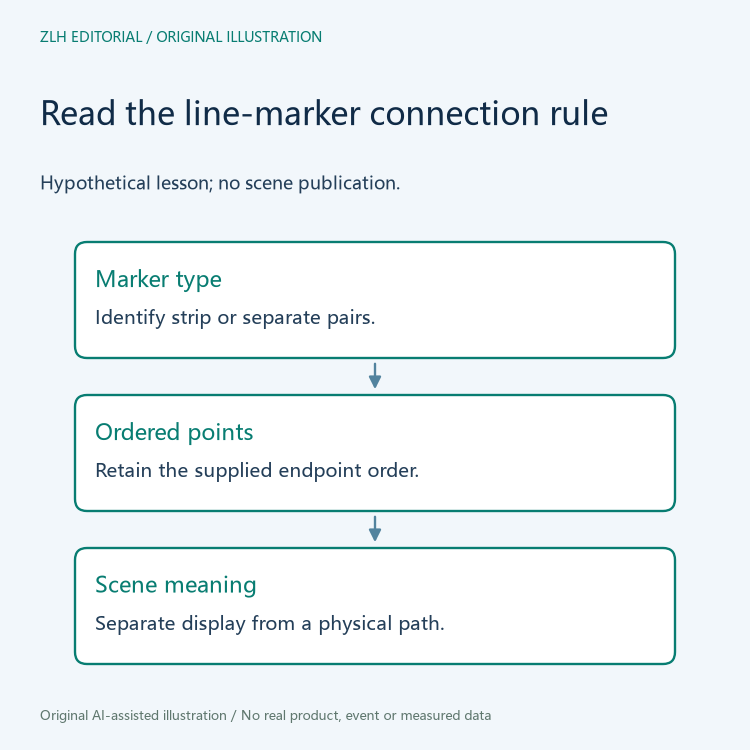
Keep width and placement in their documented roles
For both line types, the tutorial specifies scale.x as the line-segment width. It also says the marker pose still transforms the points and relates the lines to the header frame. A learning summary should not replace the connection rule with a generic explanation of scale or assume that points alone describe every placement condition.
A useful hypothetical table can retain the marker type, ordered-point source, connection rule, width explanation, and frame context. These properties answer different questions. A wider visible segment does not establish a longer geometric segment, and a shared point list does not establish a shared connection pattern. No actual width or length is evaluated here.
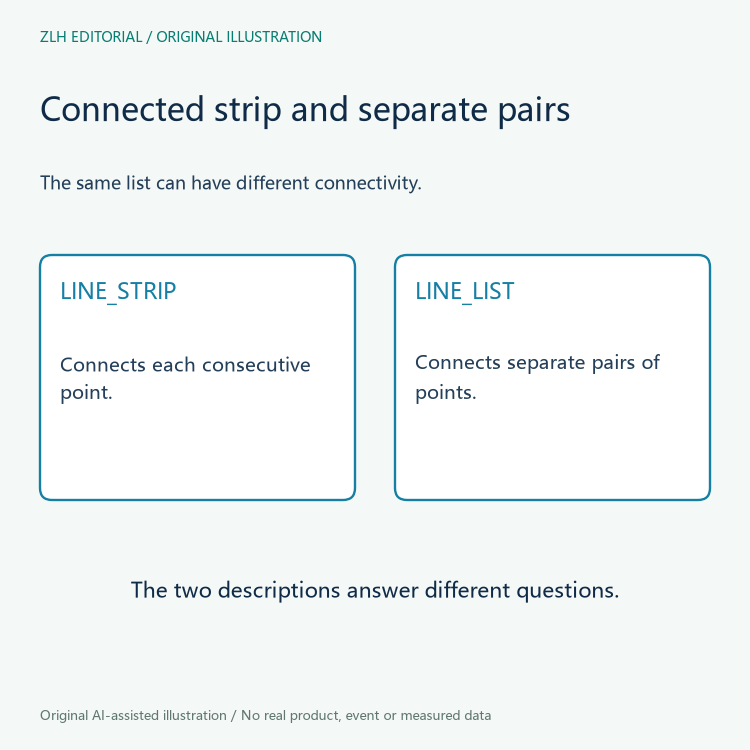
Separate line connectivity from the meaning of the scene
A line marker may illustrate many things in a lesson. It is not automatically an executed robot trajectory, a physical cable, or a measured object boundary. The contributor should state what the visual representation is intended to explain. Correctly identifying strip versus list clarifies the display semantics without validating the physical interpretation attached to it.
For example, a fictional caption might call a set of separate segments a complete connected perimeter. The reviewer can ask whether the type and ordered endpoints support that explanation. A response may require a clearer caption rather than a different underlying point list. This article does not diagnose a real scene or ask the reader to change a publisher.
The connection question is also separate from marker identity and display duration. Knowing which object a message updates does not tell a learner which endpoints are joined inside that object's line representation. Retain both kinds of explanation when needed, rather than treating an identifier as a definition of the internal geometry. The present article focuses on connectivity.
When a lesson is revised, record whether the change concerns the marker type, point ordering, or prose. Those are different revisions. A newly rendered screenshot should keep its version relationship to the earlier materials; it should not silently become evidence of what an earlier scene displayed. No scene has been rendered or observed in this documentation review.
One practical question is “does this type connect every neighboring point, or only the listed pairs?” The answer should point to the documented type and actual supplied list. If either is missing, preserve that gap instead of inventing a connection pattern. This keeps the learning review specific without requiring hardware access or pretending a conceptual line is a measured path.
The original figures show a documentation sequence and compare connection rules without numeric endpoints or a robot model. Continue through the robot learning documentation section and related resources section. Naming strip and pair connectivity makes a visual lesson easier to follow while leaving physical-route conclusions to evidence that actually addresses them.


