

Pneumatic Cylinder Roles: One Air Side or Two
2026-11-06
Pneumatic Cylinder Roles: One Air Side or Two
Pneumatic Cylinder Roles become clearer when the movement of the piston rod is separated from the source of force that produces each movement. A single-acting cylinder can advance and retract, although compressed air drives only one of those directions in the spring-return examples discussed here. A double-acting cylinder uses compressed air for both directions. Festo's round and compact cylinder catalogues show the distinction alongside other independent construction choices.
Single acting identifies the air-driven side
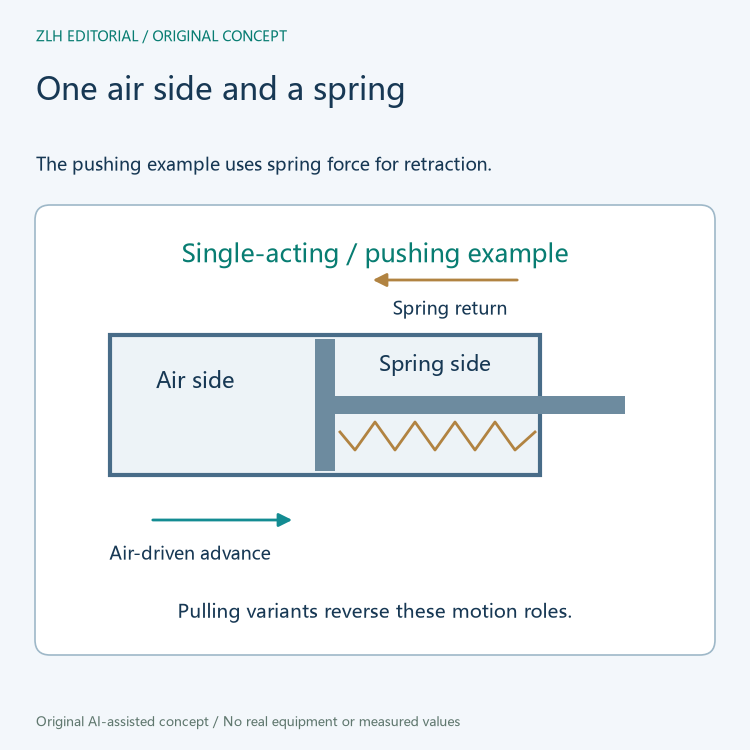
The official DPRA Round Cylinders catalogue, marked July 2021, describes single-acting versions with one pneumatic connection. Its pushing version uses compressed air to advance the piston rod and a spring to retract it. The rod therefore moves in two directions even though the pneumatic force is associated with one direction.
That relationship prevents a common reading error: single acting does not mean that the rod can move only once or travel only outward. The classification describes how the actuator supplies the motion. A technical illustration should identify the spring and the air-driven motion, rather than rely on one arrow beside an otherwise unlabeled cylinder silhouette.
Pulling changes which direction the spring produces
The same DPRA characteristics chapter separately describes the pulling version. Here the rod is initially advanced by spring force, while compressed air produces retraction. Removing the word pulling from a shortened description would lose the distinction between this version and the pushing version, even though both are single acting.
For a robot-peripheral inventory, retain the complete action description and the identified product. A generic spring-return label is incomplete when the reader needs to know whether the spring advances or retracts the rod. The catalogue describes the cylinder's construction; the condition of a complete installed mechanism also depends on its actual arrangement and cannot be reconstructed from that label alone.
Double acting assigns compressed air to both directions
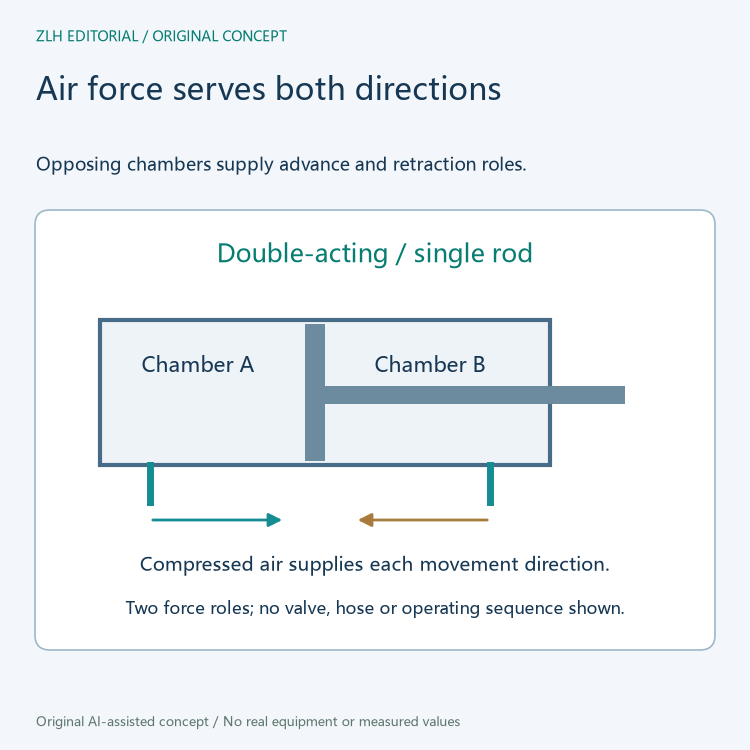
For the double-acting DPRA version, Festo describes two pneumatic connections and explains that compressed air acting from opposite ends produces advance and retraction. In this construction, the two directions are supplied through the cylinder's pneumatic chambers rather than through one air-driven direction and an opposing return spring.
This is a functional description of the manufacturer's actuator, not a pneumatic circuit. A circuit also involves other components and its own applicable documentation. Counting two directions of rod travel in a video would not establish whether an unidentified cylinder is double acting, because the single-acting spring-return examples also travel both ways.
The compact-cylinder catalogue confirms the same distinction
The official DPCA Compact Cylinders catalogue, marked May 2023, lists double-acting, single-acting pulling and single-acting pushing versions in its key-features chapter. It gives the same air-versus-spring relationships while describing a different cylinder family. The terminology is therefore shown with explicit manufacturer examples, rather than inferred from the external round or compact shape.
The two catalogues also list protection against rod rotation as a separate option. That feature concerns whether the rod turns during movement. It does not replace the action description, which concerns the force source associated with advance and retraction. A cylinder can need both attributes in its record because they answer different mechanical questions.
Rod arrangement is another independent construction choice
Both documents distinguish a rod available at one end from through-rod constructions. The DPRA description identifies equal forward and return forces for its through-rod arrangement. The DPCA key features also identify a through, hollow rod and explain that the hollow passage can carry vacuum or compressed air. These are stated construction features of the listed variants.
A through rod should therefore not be translated into a second action merely because it appears at both ends. Similarly, a hollow passage is not the same description as the working chambers that move the piston. Keep the function and rod construction associated with the exact catalogue entry instead of combining separate options into a fictional universal cylinder.
Keep cushioning and sensing attached to their own roles
The characteristics chapters separately list end-position cushioning and position-sensing options. Their placement reinforces the catalogue's structure: action, rod construction, rotation restraint, cushioning and sensing describe different aspects of the actuator. One attribute cannot establish the presence of the others. A compact description remains useful when it retains the relevant original terms rather than replacing them all with a generic automation-ready label.
The relevant complete characteristics chapters were read on November 6, 2026, including the dated page headings and function illustrations. The original figures explain force roles without hose connections, valve symbols or operating instructions. Related reading appears in the robotics learning collection and technical reference directory. Pneumatic Cylinder Roles are explicit when each direction of rod movement remains connected to its actual force source.


